

The Texas Legislature’s Property Tax Relief Efforts Are Not Working.
Despite Politicians’ Promises, Texans Are Not Getting Property Tax Relief
Last year, Texas politicians promised billions of dollars in property tax relief for Texans. Here are some examples:
“Do you think your property taxes are too high? So do I, and I’m going to sign three pieces of legislation that lower those taxes.” – Gov. Greg Abbott
“Homeowners under 65 years old will now see almost 50% of their school taxes cut.” – Lt. Gov. Dan Patrick
“With the Legislature’s overwhelming passage of additional property tax relief, Texas home and business owners are on their way to keeping more of their hard-earned money,” – House Speaker Dustin Burrows.
However, new data from the Texas Comptroller’s1 office show that, overall, property taxes increased instead.
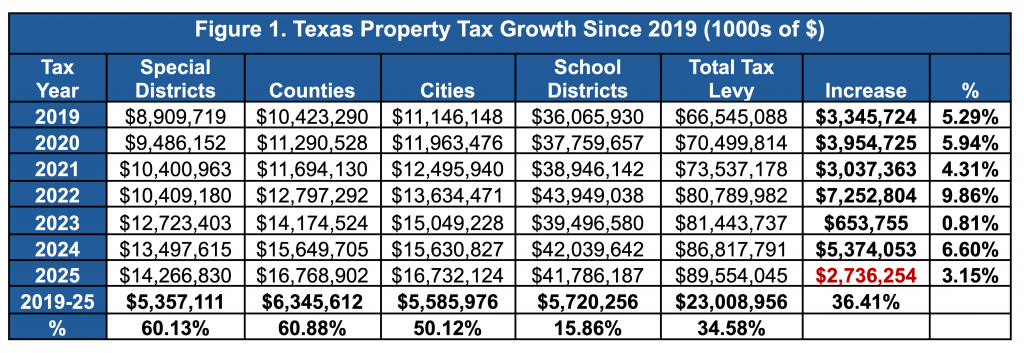
Figure 1 shows that total property tax revenue in Texas increased by $2.7 billion in 2025. Even school property taxes dipped by only $253 million, despite the promise of a 50% tax cut. This means that the Legislature is spending an additional $6.5 billion on public schools in the name of property tax relief and only bought a quarter-billion-dollar reduction in school property taxes. At the same time, property tax revenue collected by cities, counties, and special districts increased by $3 billion.
There was no relief.
Why Are the Legislature’s Property Tax Efforts Failing?
The main hindrance to relief is that local governments and schools keep spending more money and raising taxes to pay it. This undercuts the Legislature’s efforts. For instance, the average property tax rate for cities in 2025 was $0.4809, up from $0.4740 in 2024. Combining that with a $136.5 billion increase in taxable value explains why city property tax revenue was up 7% in 2025.
Another problem shows up with school taxes. Despite the Legislature spending $6.5 billion in an effort to remove property tax value off the tax rolls through increasing the homestead exemption, the total value of taxable property increased slightly in 2025. The current relief effort is not working because it is poorly designed.
The chart below shows that these problems are not new. Every session since 2015 that the Texas Legislature has attempted to provide property tax relief, instead we have seen large increases in property tax revenue. Some people, primarily homeowners, have seen short term tax cuts.
But they are almost always temporary; after the first year of a reduction, taxes start increasing again.
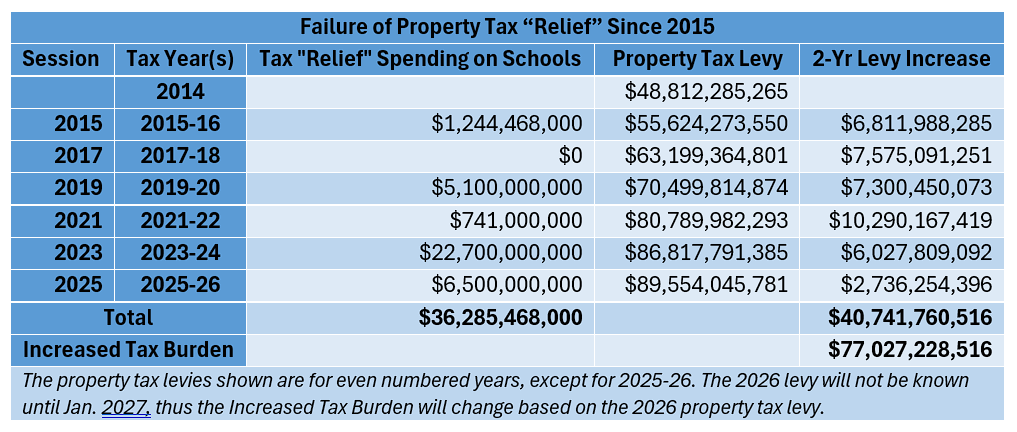
The result is a higher tax burden on Texans. The direct property tax burden since 2015 has increased by $40.7 billion. Meanwhile, state spending on public schools attributable to “property tax relief” has increased by $36.3 billion. This means Texans are paying $77 billion more today than in 2015 to support property tax-related expenditures. If property taxes were declining, we could discuss whether the tradeoff is worth it. But these numbers make clear that the property tax “relief” efforts over the past decade have been a complete failure.
Politicians Are Getting Weary of Property Tax Relief
At some level, Texas politicians seem to understand this. Last legislative session, for instance, there were reports2 that members were getting “weary” of paying for property tax relief. State Sen. Charles Perry echoed this sentiment3 at a conference last fall:
“Texas runs a pretty lean budget. We’ve spent money, I can agree, that we shouldn’t have on different things, but generally speaking, our budget is tied up in roads, schools and Medicaid. That’s it. So tell me which one of those you want to do less of. We’re kind of maxed out at what we can do for property tax reform, from a budget perspective.”
It is important to note that Sen. Perry does not seem worried about the failure of the Texas Legislature to provide real property tax relief for Texans. Instead, he is concerned about the money going to property tax relief that could be spent instead on other things. He also appears to not understand the increasing tax burden on Texas taxpayers.
There is no excuse for the failure of legislators to recognize the problems with their approach to property tax relief over the last decade. It was entirely predictable.
In fact, we did just that last year in the article, Texas Property Taxes Expected to Increase by $2.5 Billion This Year.4 Published on April 17, the article projected property tax revenue for 2025:
“Legislators are providing “relief” this session the exact same way they have previously. … Using recent trends in property tax revenue growth and property tax relief efforts, we project that the statewide total tax levy for all Texans will increase by $2,502,347,747 this year.”
The Path Forward to Real, Lasting Property Tax Relief
It is also predictable that more of the same approach to property tax relief will not work in 2027. The only way to achieve true property tax relief is to scrap what the Legislature has been doing since 2015 and start over again.
Here are five steps we should take to make this happen:
Step 1: Stop the Growth of Property Taxes
Many Texans, rightfully so, want to eliminate all property taxes. They are tired of paying rent to the state for their own property. And they too are weary of the continued failure of the state’s recent efforts.
To make this happen, taxpayers should deal with the most pressing issue at hand—stopping out-of-control property tax increases. If we do not stop the increases, we will never be able to eliminate property taxes in Texas.
To do this, we can turn to a plan announced last year by Gov. Abbott.5 In his plan, the Governor provides an elegant solution for slowing or stopping local property tax increases. He would “require two-thirds voter approval for tax increases.” This means (assuming it is taken to its full potential in legislation) that if a school, city, county, or special district wants to increase its property tax revenue in a given year, they must ask the voters for permission to do so. And two-thirds of the voters will have to say yes. It is as simple as that.
To make this work, however, we need to pay attention to the details. Texas’ property tax code is very complicated. This complexity allows local governments to take advantage of loopholes to exceed the current limits on property tax increases.
For instance, although voter approval is supposedly required for increasing city and county property taxes by more than 3.5%, since 2019 city property tax revenue has increased by 7.1% annually and county revenue by 8.5%. If Gov. Abbott’s proposal is going to work, Texas must replace all the loopholes with a simple formula: if a school or local government wants to increase its current year’s property tax revenue by any amount in next year’s budget, they have to ask the voters. In other words, the Voter Approval Rate would be any rate that increases property tax revenue by more than $0.00.
Step 2: Reduce Current Property Taxes
Once we’ve stopped local governments from forcing property tax increases on taxpayers without their approval, the next question is, how do we start to actually reduce property taxes? We’ve already seen that the Texas Legislature’s current efforts will not work.
Fortunately, Gov. Abbott has a plan for this as well. He wants to “empower voters to roll back taxes.” Under his plan, “if 15% of registered voters in a local area sign a petition, they can force a rollback election to lower rates.” The beauty of this is that, for decades, Texans have had to rely on the Texas Legislature to do something about property taxes. They have failed us. Under this plan, we can take matters into our own hands. We must make sure, though, the rollback effort focuses on revenue, not rates; this measure should cut the actual amount of money Texans pay on their property tax bill.
Step 3: Slow—or Stop—State and Local Spending Growth
To successfully eliminate property taxes, we need to understand why the current approach is not working. The truth of the matter is that many Texas politicians do not want to eliminate property taxes because they do not want to stop spending our money. As a result, they have come up with half-hearted plans that don’t accomplish anything meaningful.
Only fiscal discipline can deal with the primary cause of runaway property tax increases: runaway SPENDING increases by school districts, cities, counties, and special districts.
A look at the numbers helps explain this problem.
Total state tax revenue in 2025 was $84.2 billion. Property tax revenue in 2025 $89.5 billion. To eliminate property taxes without fiscal discipline means Texas would have to double state tax revenue. However, if we stop the growth of spending at the local and state levels, continued economic growth will provide the resources needed to eliminate property taxes. Here is how we can do this:
Stop the Runaway Growth of State Spending
- Freeze state appropriations at current levels
- Cut all waste, fraud, abuse, inappropriate and unnecessary spending from the budget
- Implement stronger state spending limits in the constitution
- Freeze/cut state spending = larger surpluses for tax relief
- This will shrink the size of the state relative to the economy and taxpayers, make Texas’ economic future more sustainable and secure
Stop the Runaway Growth of Local Spending
- Common-sense spending increase limits on all local entities, capped at the lesser of population growth+inflation or 3.5%, whichever is less. Two-thirds of voters would be required to exceed this limit
Step 4: Eliminate School M&O Property Taxes
With the above reforms in place, Texans can then turn to eliminating property taxes. The best place to start with that is to eliminate school M&O property taxes. The reason for starting here is that school M&O taxes make up the largest portion of property taxes, about $32 billion annually. Eliminating them by shifting costs to the state would provide meaningful relief without needing any complex changes to law or funding structures because school funding already flows through state formulas. Two steps would be needed to accomplish this: 1) freeze school M&O property taxes; 2) replace school property tax revenue with state revenue with the budget surpluses produced through fiscal discipline.
This will work because the state’s general revenue growth averages 5.45% annually. By limiting state spending growth to, say, 2% annually (or less, with the ideal being a frozen budget), the current revenue base of $85 billion would create annual revenue surpluses of about $4.5 billion per year. This would be enough to eliminate school M&O taxes within eight to ten years (or sooner assuming more aggressive cuts in state expenditures). During that time, in conjunction with a new voter approval rate and rollbacks, the total property tax burden could decline as much as $32 billion annually.
Step 5: Eliminate All Property Taxes
After eliminating school M&O taxes, attention then could shift to eliminating remaining property taxes, those levied by cities, counties, special districts, and school I&S (debt service). At the time the school M&O is eliminated, annual property tax revenue from school I&S, cities, counties, and special districts would likely be between $45 billion and $69 billion (depending on how well voters discipline local governments using the voter approval and roll back mechanisms). State general revenue would be about $142 billion. This would generate on average a $6 billion annual surplus over the next 7 to 12 years, which would be how long it would take to eliminate all Texas property taxes if we use state revenue to accomplish this.
However, eliminating city, county, and special district property taxes presents challenges not present when eliminating school property taxes. All school funding flows through state formulas so accommodating the end of school property taxes simply requires tweaking the formulas. This is not the case with other local property tax entities whose revenue is mostly disconnected from the state appropriations process. How to properly distribute state revenue to make up for the loss of property tax revenue would be a complex question. It might be possible for larger cities and counties to eliminate their property taxes with little help from the state through spending cuts, relying on revenue growth, and increasing other local taxes and fees. These complexities are why eliminating city, county, and special district property taxes should wait until after the school M&O tax is eliminated.
Conclusion
It is true that properly eliminating property taxes will take some time if we want to also reduce government spending (and thus the size and scope of government) and the overall tax burden on Texans; we did not get ourselves into this mess overnight. Yet, under the five-step plan above, Texans will experience property tax relief almost immediately—unlike the last 10 years of empty promises.
During the transition period, we can also eliminate much of the problem that comes from being ‘renters’ of our own property. Currently, if a property owner is late on his taxes the owner enters into default immediately and the local taxing entity—usually through a private law firm or collection agency—begins the process of enforcing the tax lien (automatically placed on every property each January 1) on the property. This soon ends in foreclosure and the sale of the property to pay back taxes and penalties. The way to end this is by eliminating the automatic annual liens and instead make the local taxing entity go through the same debt collection process as other debtors, such as the state of Texas on delinquent sales tax payments. This will end the grotesquely excessive penalties levied through the current process and require the local taxing entity to work with the property owner to resolve the problem equitably; often allowing the property owner to retain his property.
Some people will be impatient with the Five Step approach. We should remember, though, that Texas has been trying to eliminate property taxes for the last 10 years and it has not worked. In fact, things have gotten worse. Texans need to eliminate all the distractions that Texas politicians are putting in the way of property tax elimination. To do that, we should first focus on stopping property tax increases without voter approval so Texas politicians will have to focus on that as well—no more excuses. Once that is done, eliminating property taxes will be much more realistic.
Texans for Fiscal Responsibility relies on the support of private donors across the Lone Star State in order to promote fiscal responsibility and pro-taxpayer government in Texas. Please consider supporting our efforts! Thank you!
Get The Fiscal Note, our free weekly roll-up on all the current events that could impact your wallet. Subscribe today!
- https://comptroller.texas.gov ↩︎
- https://texastaxpayers.com/the-texas-legislature-is-tiring-of-property-tax-relief/ ↩︎
- https://texastaxpayers.com/setting-the-record-straight-on-property-taxes-part-1/ ↩︎
- https://texastaxpayers.com/texas-property-taxes-expected-to-increase-by-2-5-billion-this-year/ ↩︎
- https://texastaxpayers.com/abbotts-plan-to-overhaul-property-taxes/ ↩︎