

Every year, Texas taxpayers go through the same cycle.1 Appraisal districts certify property values, cities, counties, school districts and other taxing units build their proposed budgets, and then set the property tax rates that will determine how much revenue they collect. For taxpayers, the most important part of that process is happening now: local governments are debating proposed budgets and moving toward final tax-rate decisions, with many of those meetings and votes taking place in August and September.
The Texas Comptroller requires most taxing units to calculate two important numbers after receiving their certified appraisal rolls: the no-new-revenue tax rate (NNR Rate) and the voter-approval tax rate.2 The NNR rate is the rate that would generate the same amount of property tax revenue from the same properties as the previous year, taking into account any change in appraisals. It is not necessarily the same rate taxpayers paid last year. If property values rise, the NNR rate generally falls.
That distinction is critical to understand. A local government can lower its tax rate while still collecting more property tax revenue from the same property owners if property values have increased. We see and hear it all the time: local officials will brag about “lowering the tax rate.” But if that tax rate is above the NNR rate, those local officials have raised your property taxes. That is precisely why taxpayers should pay attention to the NNR rate, not simply whether their city or county’s tax rate went up or down.
The voter-approval rate is a different number. For many local taxing units, it represents the highest rate that can be adopted without triggering an automatic election for voter approval. In most cases, the voter-approval rate is higher than the NNR rate.
Texans for Fiscal Responsibility believes the default should be simple: local governments should adopt the no-new-revenue rate or lower.
Property taxes have grown exponentially in recent years, increasing nearly 78% or roughly $38 billion over the last decade,3 despite repeated property tax “relief” packages passed by the Texas Legislature. At a time when many taxpayers are being taxed out of their homes or businesses, the growth in property taxes must cease. Local governments should not treat the maximum legally available tax rate without an election as an automatic starting point for the budget.
And taxpayers should understand that adopting the NNR rate does not necessarily mean that overall property tax collections won’t increase. The NNR calculation4 excludes new property entering the tax rolls. That means a growing city or county can receive additional tax revenue from new construction and newly taxable property even while holding the tax rate at the NNR rate.
This year’s proposals show why taxpayers must remain vigilant. Here are some examples:
McKinney: City officials have proposed a FY 2027 tax rate5 of approximately $0.417876 per $100 of taxable value, up from the current rate of $0.412284, and above the NNR rate of $0.409212.6 The City Council is scheduled to consider the budget and tax rate on September 1.
Mineral Wells: The City of Mineral Wells7 has proposed a FY 2027 property tax rate of $0.7007075 per $100 of taxable value, a 22.55% increase over the prior year and well above the city’s calculated no-new-revenue rate of $0.5931530. This would increase the typical homeowner’s annual city tax bill from $535.95 to $1,027.59, a one-year jump of nearly $492, or over 91%.8
Dallas: The Dallas City Manager has proposed a FY 2027 property tax rate of 69.78 cents9 per $100 of valuation, a 0.1-cent reduction from the current 69.88-cent rate. The proposal is part of a $5.66 billion budget that increases general-fund spending and raises over $84 million in additional property tax revenue over the previous year, $27 million of which is from new property. The City Council has not yet adopted the budget or tax rate; with final adoption scheduled for September 16.
San Antonio: The San Antonio City Manager has proposed raising the FY 2027 property tax rate from the current 54.159 cents to 56.288 cents10 per $100 of taxable value. The increase incorporates unused increment capacity and exceeds the no-new-revenue rate, generating additional revenue while remaining within the voter-approval threshold. The City Council has not yet adopted the budget or tax rate; with the final vote scheduled for September 17.
Fort Worth: The Fort Worth11 City Manager has proposed a FY 2027 property tax rate of $0.7020 per $100 of valuation,12 up 3.2 cents from the current $0.6700 rate. The proposed rate exceeds the no-new-revenue rate of approximately $0.6704. The final vote is scheduled for the September 15 meeting.
Princeton: The City of Princeton13 has proposed a FY 2027 property tax rate significantly above its calculated NNR rate. The City Council formally approved the NNR rate of $0.445102 per $100 and a proposed rate of $0.549999 (a nearly 25% increase), which would raise the typical homeowner’s city tax bill by nearly $288.14
There are also examples showing that adopting the NNR rate, or even reducing the rate below the NNR rate, is possible:
Tarrant County: In a clear contrast to many local governments seeking rate increases, Tarrant County15 is once again proposing to lower property taxes. County Judge Tim O’Hare has given preliminary approval to a Fiscal Year 2027 budget that sets the county tax rate at $0.1860 per $100 of valuation and the JPS Hospital District rate at $0.1590. Both rates sit below the NNR rate, meaning the county will collect less property tax revenue from existing properties than last year. This marks the fourth consecutive year Tarrant County has adopted rates below the NNR threshold, delivering cumulative taxpayer savings of roughly $1.2 billion.
Grapevine: Officials in Grapevine16 have proposed a FY 2027 property tax rate of $0.226817, exactly equal to its NNR rate, and nearly 4.4% below the city’s current rate, and the city has scheduled its budget adoption vote for September 1, and the tax-rate adoption for September 15.17
These examples illustrate an important point: taxpayers have an opportunity to hold their elected officials accountable, if they stay engaged. Local officials are not simply handed a tax rate by the state. They propose a budget, hold public meetings, and ultimately vote on the tax rate themselves.
Texas law also expressly gives taxpayers the right18 to voice their opinions at open public meetings concerning proposed tax rates and to ask questions of the governing body responsible for setting them.
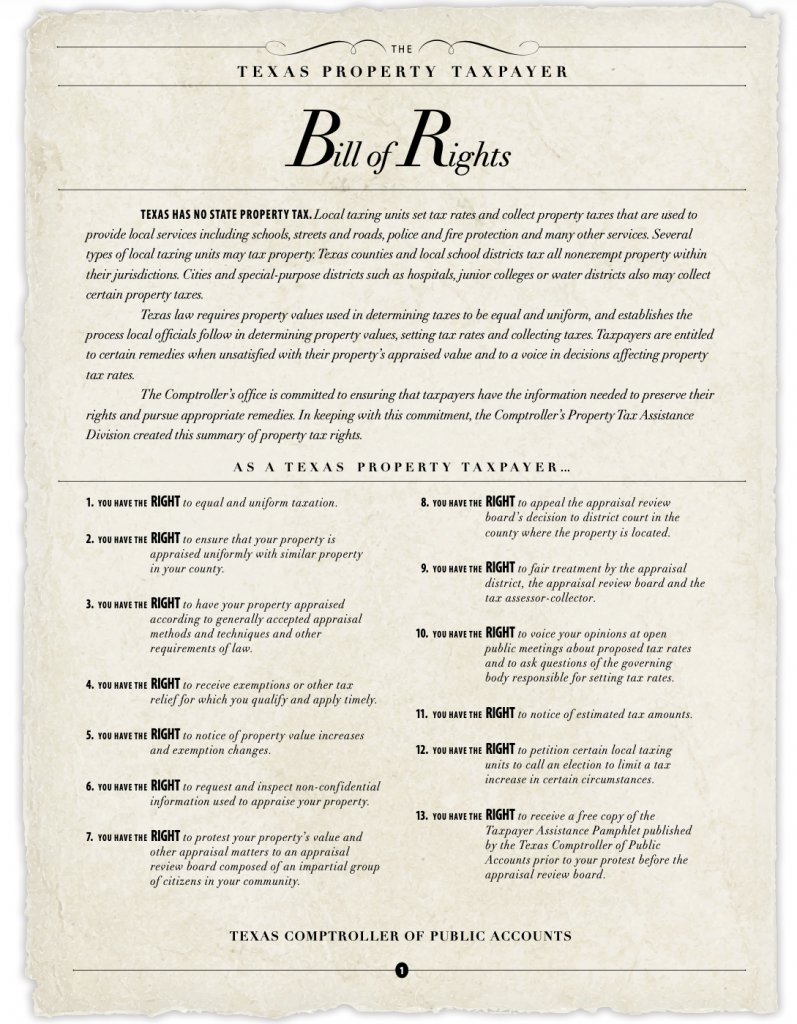
So what should taxpayers do?
First, find your local taxing units and their proposed budgets and tax rates. Your individual tax bill can include taxes from a city, county, school district and various special districts. The Texas Comptroller’s property tax resources19 provide access to information about local taxing units.
Second, compare the proposed rate to the NNR rate. Do not stop at the phrase “tax rate.” Ask whether the proposed rate is above, equal to, or below NNR. The Comptroller requires20 most local taxing units to publish the NNR and voter-approval rates along with information about the proposed rate and the date of the tax-rate meeting.
Third, show up. Attend city council meetings, commissioners court meetings and other public hearings where budgets and tax rates are being discussed. If you cannot attend in person, look for livestreams, agendas, and opportunities to submit comments.
Finally, ask the question local officials should be prepared to answer: Why isn’t the no-new-revenue rate enough?
Taxpayers should not accept “because the law allows it” as an answer. Nor should they accept that “rapid growth” requires higher property taxes. New growth already means new tax revenue. The NNR rate exists specifically to give taxpayers an apples-to-apples benchmark for what it would take to maintain the same level of property tax revenue from the same properties.
Before another property tax bill arrives in the mail, taxpayers have an opportunity to make their voices heard. Taxpayers engaging with their local taxing entities should politely, but firmly, demand responsible budgeting and spending discipline.
Texans for Fiscal Responsibility relies on the support of private donors across the Lone Star State in order to promote fiscal responsibility and pro-taxpayer government in Texas. Please consider supporting our efforts! Thank you!
Get The Fiscal Note, our free weekly roll-up on all the current events that could impact your wallet. Subscribe today!
- https://comptroller.texas.gov/taxes/property-tax/basics.php?darkschemeovr=1&safesearch=off&setlang=en-US&ssp=1&utm ↩︎
- https://comptroller.texas.gov/taxes/property-tax/truth-in-taxation/calculations.php ↩︎
- https://texastaxpayers.com/a-decade-of-government-growth-property-taxes/ ↩︎
- https://comptroller.texas.gov/taxes/property-tax/docs/98-1047.pdf ↩︎
- https://communityimpact.com/mckinney/government/mckinney-officials-propose-880m-budget-increased-tax-rate-for-fy-2026-27/ ↩︎
- https://mckinneytx.new.swagit.com/videos/395543 ↩︎
- https://www.mineralwellstx.gov/DocumentCenter/View/9834/MWC-2026-50-878-Notice-of-Public-Hearing-De-Minimis ↩︎
- https://www.texaspolicy.com/higher-taxes-on-the-horizon-city-of-mineral-wells/ ↩︎
- https://dallascityhall.com/departments/budget/financialtransparency/AnnualBudget/FY%202025-26%20Proposed%20Budget/0.%20Complete%20FY%202026-27%20Proposed%20Budget.pdf ↩︎
- https://www.sa.gov/Directory/News-Releases/Fiscal-Year-2027-Proposed-Budget-Presented-to-Mayor-City-Council ↩︎
- https://texastaxpayers.com/fort-worths-budget-shortfall-demands-spending-discipline-not-more-taxes/ ↩︎
- https://www.fortworthtexas.gov/departments/the-fwlab/budget/fy2027 ↩︎
- https://princetontx.gov/DocumentCenter/View/8792/2026-Notice-of-Public-Hearing-Princeton-City?bidId= ↩︎
- https://www.texaspolicy.com/higher-taxes-on-the-horizon-city-of-princeton/ ↩︎
- https://texastaxpayers.com/tarrant-county-on-track-to-cut-property-taxes-again/ ↩︎
- https://grapevinetexas.gov/113/Taxes ↩︎
- https://communityimpact.com/grapevine-colleyville-southlake/government/grapevine-officials-propose-2624m-budget-no-new-revenue-tax-rate/ ↩︎
- https://comptroller.texas.gov/taxes/property-tax/bill-of-rights.php? ↩︎
- https://comptroller.texas.gov/taxes/property-tax/ ↩︎
- https://comptroller.texas.gov/taxes/property-tax/truth-in-taxation/notices.php ↩︎