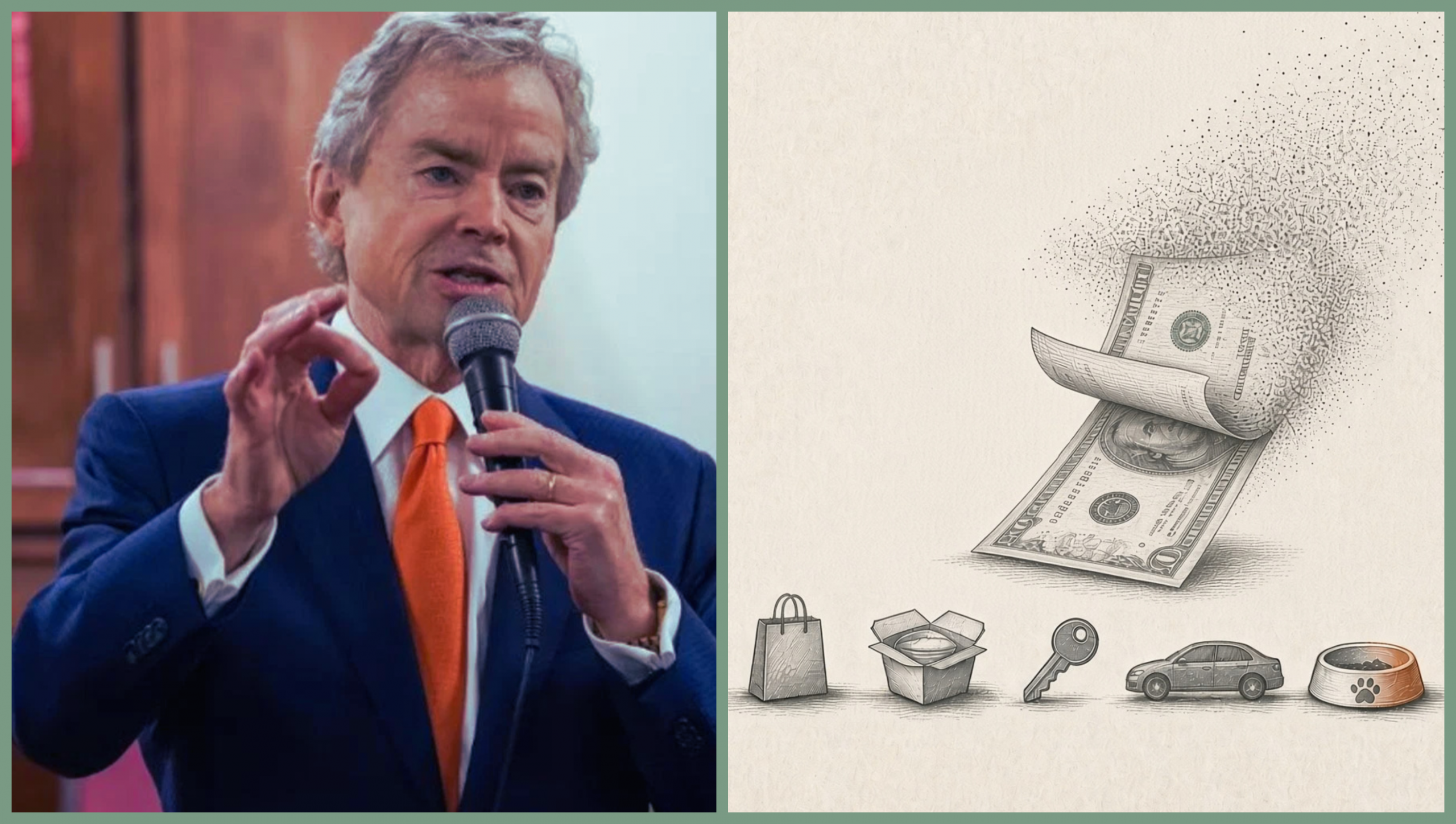


State spending in Texas has swelled by leaps and bounds in the last decade, growing 42% over the last four years alone. But for the first time since 2020, state leaders have signaled that fiscal restraint is necessary ahead of next session. But is it enough?
The Directive
This week, Governor Greg Abbott, Lieutenant Governor Dan Patrick, and House Speaker Dustin Burrows sent a message1 to state agencies: trim your baseline budget requests for the 2028-29 biennium by three percent.
For anyone who’s watched Texas government’s appetite grow over the years, this feels like a breath of fresh air. After multiple budget cycles of hefty increases that far outpaced population and inflation growth. State spending has grown by 42% in state funds in just the last four years2 (and by a whopping 78% in the last decade).3 But now, leadership at the top is at least acknowledging4 that agencies should not treat the prior year’s spending as a sacred baseline. The guidance directs most departments to start from a lower point, forcing them to justify their needs more carefully.
This is the encouraging part. Texans for Fiscal Responsibility has long argued that good government starts with spending discipline at every level, especially if eliminating the crushing toll of property taxes is to be addressed. Governor Abbott himself recently highlighted this truth on the campaign trail, explicitly stating5 that the state, “has an obligation to cut our spending also… to focus on eliminating property taxes.” This week’s joint directive aligns with that thinking. Fiscal discipline is the key.6
Requests vs Spending
Yet this small step must be tempered with realism, even if leaders are moving in the right direction on the campaign trail. A three percent reduction in “requests” is not the same as three percent less “spending,” as evidenced by previous budget cycles. Agencies can still seek more taxpayer money through “exceptional items,” and the instructions come loaded with carve-outs for big-ticket areas: the Foundation School Program, Medicaid, debt service, pensions, and more. And after years of some of the most rapid expansion of state spending in Texas history, a modest trim in the opening bid barely dents the momentum.
Previous calls for reductions, such as in 20167 and 2020,8 included directives for state agencies to submit requests with reductions of 4% and 5%, respectively. In 2020, for example, this led to roughly $1 billion in agency cuts. But even with the directives and the reduction in agency spending, state spending has not seen a net reduction.9 Though some of the state surpluses10 over the years have gone towards property tax relief, most of them have gone towards new government programs, ongoing state programs, and towards other appropriations like corporate welfare, such as the Texas Energy Fund, the Texas Broadband Fund, handouts for Hollywood, or the Texas Dementia Institute.
This session, the budget starts in the Texas House, with what will be HB 1. That means the 90th meeting of the Texas Legislature will give House members the first opportunity to chart a different path. If fiscal discipline is insisted upon and real spending cuts are made, taxpayers and families will perhaps see the elimination of the largest portion of their property tax bill: school maintenance and operations property taxes.
But the core problem remains: Texans’ tax burdens, especially the school M&O portion hitting property owners the hardest, won’t get lowered or eliminated through wishful thinking or one-off band aids. Local governments keep raising levies because their spending keeps climbing. Property taxes are at record levels, jumping $2.7 billion last year alone.11 And the more the state spends on bigger government, the less revenue is available for property tax relief.
Real Fiscal Discipline
This directive is a good first step because it sets a tone. It tells bureaucrats atop state agencies that blank-check budgeting isn’t the default next biennium. It reinforces the message that every taxpayer dollar should be scrutinized for necessity and efficiency. But in a state blessed with a strong economy, the temptation to spend more is constant. The state must choose fiscal discipline and actual spending cuts over simply “slowing” the growth.
True fiscal discipline means structural changes that outlast any single budget cycle.
Texas must actually cut state spending. Implementing zero-based budgeting, as is called for in the newly adopted RPT Legislative Priorities,12 would be a crucial change that far outlasts any one-time directive or accounting gimmick. Common-sense spending limits must be imposed on all local taxing entities, since spending is what drives up taxes. Sunset reviews should be more rigorous, eliminating programs that have outlived their usefulness, duplicate existing efforts, or fall outside the core functions of government. Lawmakers should abolish government programs that have been riddled with corruption and prey on the very people government is meant to protect, like the scandal-plagued Texas Lottery. Corporate welfare must be eliminated. And the state must be bold in freezing school district property taxes and aggressively eliminating them for all property owners by assuming the responsibility for funding our public schools.
Texans aren’t meant to fund an ever-growing government. In fact, many people from other states have come here to join in Texas’ promise of opportunity, lower taxes, and the chance to keep more of what they earn. Texans are meant to flourish, create, and provide for their families in a free and fair environment. Government that continues to outgrow the taxpayer’s ability to pay for it is the antithesis of the American Dream and the Texas Promise.
The 90th Legislature must build on this directive by rejecting the spending spree of recent years and delivering a budget that doesn’t just slow the growth, but actually reduces spending and the size and scope of government.
Eliminating school property taxes isn’t a pipe dream—it is a goal within reach if spending restraint becomes the rule. Now it is time for follow-through: bolder cuts, harder choices, and a commitment to putting Texas families first by leaving more money in their pockets and less government intertwined with their everyday lives.
Texans for Fiscal Responsibility relies on the support of private donors across the Lone Star State in order to promote fiscal responsibility and pro-taxpayer government in Texas. Please consider supporting our efforts! Thank you!
Get The Fiscal Note, our free weekly roll-up on all the current events that could impact your wallet. Subscribe today!
- https://gov.texas.gov/uploads/files/press/90R-LAR-Policy-Letter-Final-07.14.2026.pdf ↩︎
- https://texastaxpayers.com/texas-government-keeps-getting-bigger/ ↩︎
- https://texastaxpayers.com/a-decade-of-government-growth-legislative-appropriations/ ↩︎
- https://gov.texas.gov/news/post/governor-abbott-lt-governor-patrick-speaker-burrows-issue-joint-guidance-on-2028-29-budget-priorities ↩︎
- https://x.com/Texas_Taxpayers/status/2074872273119387746/video/1 ↩︎
- https://texastaxpayers.com/fiscal-discipline-is-essential-to-the-property-tax-problem/ ↩︎
- https://texasscorecard.com/uncategorized/state-leaders-demand-budget-cuts/ ↩︎
- https://www.elpasotimes.com/story/news/politics/2020/05/20/state-agencies-higher-education-institutions-instructed-cut-budge-5/5229863002/ ↩︎
- https://texastaxpayers.com/texas-government-keeps-getting-bigger/ ↩︎
- https://texastaxpayers.com/a-decade-of-government-growth-state-budget-surpluses/ ↩︎
- https://texastaxpayers.com/texas-property-taxes-increased-2-7-billion-in-2025-whats-broken-and-how-do-we-actually-fix-it/ ↩︎
- https://texasgop.org/official-documents-2/ ↩︎